
Aging Well
We Play Cards. We Don't Call It Therapy.
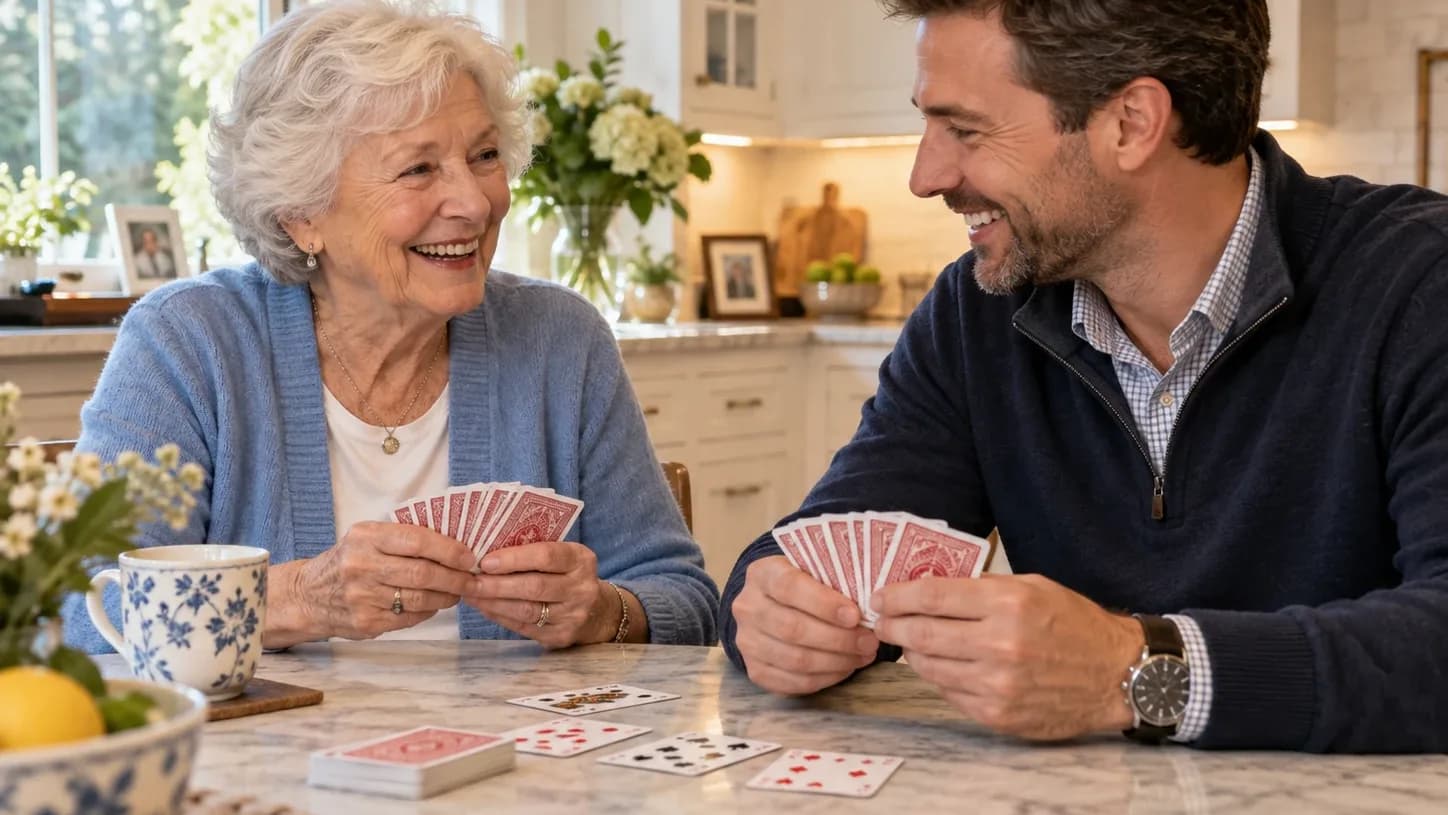
There is a version of this page that would have worked harder.
It would have called the cards a cognitive engagement protocol. It would have found a study, quoted a number, and implied — without ever quite saying — that ninety minutes a week of gin rummy does something measurable to a brain.
We're not going to write that page. Partly because we don't know if it's true. Mostly because Marjorie would find it insulting, and she'd be right.
What actually happens
Marjorie is eighty-one. She plays gin rummy in a way that suggests the rules have been settled for some time and are not open to review.
Her companion arrives on Wednesdays around two. Some Wednesdays there's a list — the pharmacy, a return, the hall light that's been out since August. Some Wednesdays there isn't, and they play cards at the kitchen table for an hour, and Marjorie wins, because Marjorie wins.
That's the visit. That's the whole thing.
Why we don't dress it up
The senior services industry has a habit of translating ordinary human activity into clinical language, and the translation always runs one direction: toward sounding more necessary.
A conversation becomes socialization support. A walk becomes mobility maintenance. Someone's daughter reads it and pictures her mother as a set of declining functions being addressed on a schedule.
Her mother, meanwhile, is a woman who has opinions about her neighbors and a strong position on how the dishwasher should be loaded.
Both things are on the page. Only one of them is true.
The honest version of the claim
Here is what we're willing to say.
People generally do better with company than without it. That's not a discovery; it's something everyone already knows from their own life. An afternoon with someone you like is better than an afternoon alone, at eighty-one and at forty-one.
What we won't say is that our visits prevent anything. We're not a medical service, we don't measure outcomes, and any company telling you a weekly card game changes a clinical trajectory is selling past what they know.
If it were that simple, it would be in the guidelines instead of the brochures.
What familiarity actually does
The part we can speak to is smaller and more practical.
The first few visits, a companion is learning. Where things are. What time is too early. That the crossword gets done in pen and is not to be touched.
Around the fourth or fifth visit, something shifts. Not because anything was achieved, but because the person stopped being a stranger. And once you know what someone's ordinary looks like, you notice when a Wednesday isn't ordinary.
She knew he normally talks the entire way through the grocery store. So she noticed the week he didn't.
That's not monitoring, and it isn't clinical. It's just what knowing someone does.
So: cards
Sometimes the visit is errands and a hall light. Sometimes it's an hour of gin rummy and a conversation about a neighbor's fence.
Both count. Neither needs a better name.
Wondering if ThereWhen is right for your family?

Tell us what life looks like now, and we’ll help you find the right support.